5 Signs Your Pool Needs Resurfacing (Don't Ignore #3)
Your pool finish faces a constant battle against the harsh Arizona sun and chemically aggressive water. We see it every season. That relentless exposure inevitably breaks down even the highest-quality plaster or pebble surfaces. Knowing the difference between a cosmetic annoyance and a structural emergency is the key to saving money.
Here are the 5 signs your pool needs resurfacing, along with the specific data on why ignoring sign #3 often leads to a full structural rebuild.
Sign #1: Rough, Sandpaper-Like Texture
What You’ll Notice: The pool floor tears up swimsuits and scrapes the bottoms of feet. We call this “pool toe,” and it turns a relaxing swim into a painful experience.
What’s Happening: Your pool chemistry has likely been aggressive over the last decade. Years of pH fluctuations erode the soft cement binder (the “cream”) that holds the aggregate together. This exposes the sharp sand or marble dust underneath.
Why It Matters:
- Safety Hazard: Skin abrasions are common, especially on children’s elbows and knees.
- Algae Growth: Rough surfaces have microscopic pits that harbor black algae roots.
- Cleaning Difficulty: Automatic vacuums wear out their tracks faster on rough surfaces.
Can It Be Fixed Without Resurfacing? Generally, no. We often hear homeowners ask about polishing or acid washing to fix this. Unfortunately, acid washing removes a thin layer of plaster. If your surface is already rough, acid washing often exposes more aggregate, making the texture even sharper.
Sign #2: Persistent Staining
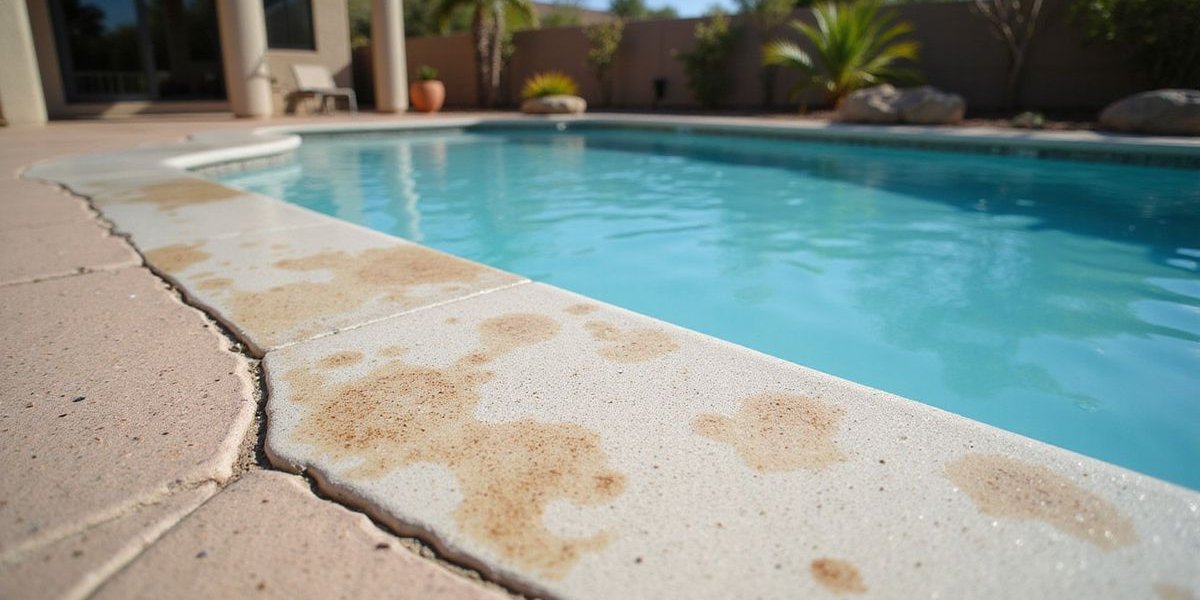
What You’ll Notice: Ugly discolorations that resist brushing and standard shock treatments. You might see blue-green streaks or dark gray blotches on the floor and walls.
What’s Happening: As pool plaster ages, it becomes more porous. Stains that used to sit on the surface now penetrate deep into the substrate where your brush cannot reach.
Common Phoenix-Area Stain Types:
- Copper Stains (Teal/Blue-Green): Often caused by low pH water dissolving the copper in heater cores or older piping.
- Calcium Scale (White/Gray): Phoenix water is notoriously hard (often exceeding 400 ppm calcium hardness), leading to rough, calcified deposits.
- Organic Stains (Brown/Green): Caused by tannins in decaying leaves or algae blooms that settled into porous plaster.
- Rebar Rust (Dark Brown/Red): A sign that water has reached the steel reinforcement (see Sign #3).
The Vitamin C Test: Before assuming you need resurfacing, hold a Vitamin C tablet against the stain for 30 seconds. If the stain lightens or disappears, it is likely metal-based and might respond to specific chelating agents. If there is no change, the stain is likely trapped deep in the plaster matrix or is organic.
Can It Be Fixed Without Resurfacing? Sometimes. Surface-level organic stains can be treated. However, if you have widespread “mottling” (gray splotches) or deep copper penetration, the material itself is permanently discolored.
Sign #3: Cracks (The One You Shouldn’t Ignore)
What You’ll Notice: Distinct fissures running along the floor, steps, or corners. These differ from “crazing” (tiny, shallow surface checks).
This is the single most expensive symptom to ignore.
Why Cracks Are Serious: Cracks provide a direct path for water to reach the steel rebar skeleton (gunite or shotcrete) that holds your pool together.
The “Oxide Jacking” Effect:
- Chlorinated water reaches the steel rebar.
- The steel begins to rust.
- Rust expands to four times the volume of the original steel.
- This massive pressure blows out chunks of concrete from the inside out.
The Cost Reality: A standard resurfacing job might cost around $12,000 to $15,000 depending on size and finish. If you wait until the shell is compromised, structural stapling and rebar repair can easily push that project over $30,000.
The Dime Test: Take a standard dime and try to insert it into the crack. If the dime fits into the fissure, it is likely structural rather than superficial. We recommend calling a professional immediately if a crack passes this test.
Can It Be Fixed Without Resurfacing? Isolated cracks can be stapled and patched. But if you have multiple cracks or “spider-webbing” across a large area, the structural integrity of the finish is gone.
Sign #4: Delamination (Peeling or Flaking)
What You’ll Notice: Areas of the pool look like blistered paint or popped blisters. You may see large chips of plaster on the pool floor or in the skimmer basket.
What’s Happening: The bond between the original gunite shell and the plaster finish has failed. This separation creates a void between layers.
The “Golf Ball” Test: You can map the extent of the damage without draining the pool. Take a golf ball or the heavy plastic handle of a screwdriver and tap the pool surface. Solid plaster makes a “click” sound. Delaminated areas make a distinct, dull “thud” or hollow sound.
Why It Matters:
- Rapid Spread: Once water gets behind the plaster, hydraulic pressure peels away surrounding areas.
- Sharp Edges: The flaking material is razor-sharp and dangerous for swimmers.
- Substrate Exposure: It leaves the structural concrete unprotected against water chemistry.
Can It Be Fixed Without Resurfacing? No. Patching a delaminated pool is like putting a band-aid on a broken leg. The bond failure usually indicates that the entire surface layer has reached the end of its useful life.
Sign #5: Excessive Water Loss
What You’ll Notice: Your auto-fill runs constantly, or you are dragging the hose out every other day.
Normal Phoenix Evaporation Rates: Understanding the baseline is critical before assuming a leak.
| Season | Daily Evaporation | Weekly Water Loss |
|---|---|---|
| Summer | 1/4” to 1/2” | ~2 to 3.5 inches |
| Winter | 1/8” to 1/4” | ~1 to 1.5 inches |
If you are losing more than these averages, the water is exiting the vessel.
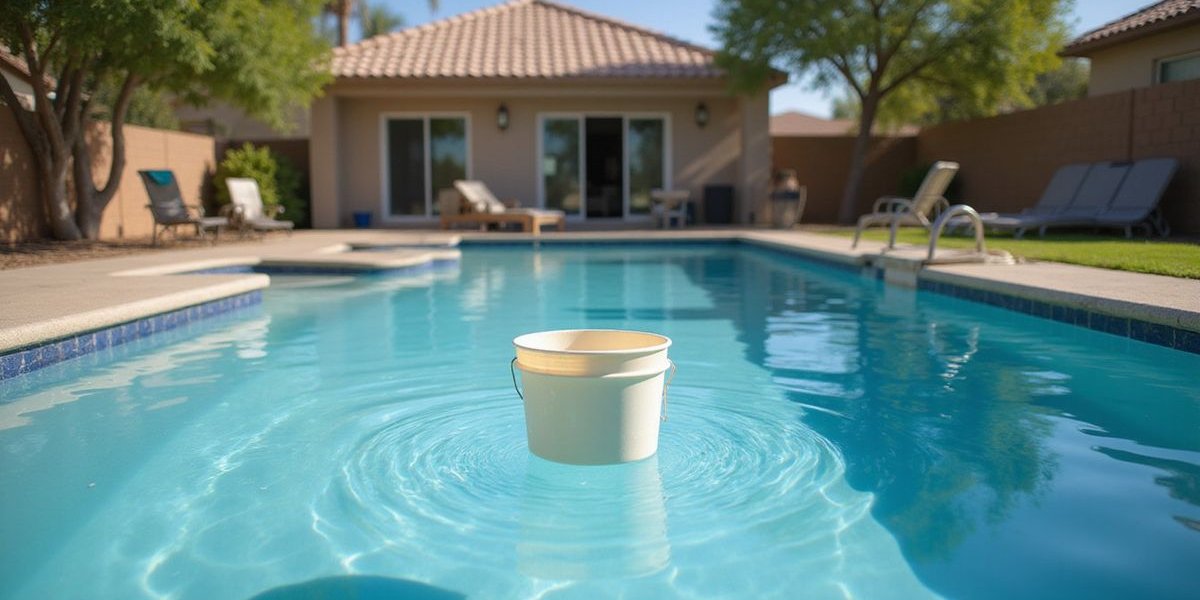
The Bucket Test: We always recommend this simple verification before calling for service:
- Fill a 5-gallon bucket with pool water about two-thirds full.
- Place it on the first or second step of the pool (so the water temps stay similar).
- Mark the water level on the inside of the bucket.
- Mark the pool water level on the outside of the bucket.
- Wait 24 hours.
If the pool level (outside mark) drops more than the bucket level (inside mark), you have a leak.
Why It Matters: Leaking water erodes the soil supporting your pool shell. Over time, this causes the pool to settle, shift, and eventually crack the main shell (see Sign #3).
Can It Be Fixed Without Resurfacing? It depends on the leak location. Plumbing leaks are fixed underground. However, if the leak is due to widespread cracks in the interior finish or failed grout lines at the tile, resurfacing is the correct repair.
What If You Only Have One Sign?
You might not see all five symptoms simultaneously. We find that different pool finishes age differently.
Here is a quick decision matrix to help you decide your next move:
| Sign | Action Required | Urgency Level |
|---|---|---|
| Rough Texture | Plan budget for next 6-12 months | Low |
| Staining | Try Vitamin C test / Stain remover | Low/Medium |
| Cracks (Hairline) | Monitor monthly | Medium |
| Cracks (>1/8 inch) | Call for inspection immediately | Critical |
| Delamination | Plan resurfacing immediately | High |
| Water Loss | Perform Bucket Test first | High |
The Cost of Waiting
Delaying necessary resurfacing is often a false economy. The damage accumulating underneath the surface is far more expensive to fix than the surface itself.
The compounding costs include:
- Chemical Waste: Porous and cracked surfaces consume 20-30% more chemicals to maintain balance.
- Water Bills: A small leak of 1 inch per day in a standard pool wastes roughly 10,000 gallons a year.
- Structural Repair: Fixing a rusted rebar grid costs thousands more than a standard resurface.
We typically see project costs rise by 15-20% when structural repairs are added to a standard resurfacing bid.
Getting a Professional Assessment
You don’t have to guess about the condition of your pool. Our team specializes in honest evaluations for Phoenix homeowners.
What our free assessment includes:
- A “sounding” of the pool shell to check for hidden delamination.
- Measurement of existing cracks.
- Identification of stain types (mineral vs. organic).
- A straightforward recommendation on whether you can wait another year.
We pride ourselves on telling you exactly what you need, not just what we want to sell.
Contact us to schedule your free pool assessment.
Related Topics
Need Pool Resurfacing Help?
Get expert advice and a free estimate for your pool project. We serve the entire Phoenix metro area.
Get Free Estimate