6 Signs Your Pool Pump Is Failing (And What to Do)
6 Signs Your Pool Pump Is Failing (And What to Do)
You know that distinct, steady hum of a working pool pump? It usually fades into the background noise of your backyard until it suddenly changes. Here in Phoenix, where equipment battles 115-degree summers, silence or strange noises are often the first clue that your pool’s heart is struggling.
David Resurface was founded with a simple mission: to provide exceptional pool remodeling and resurfacing services that customers can truly rely on. We have seen firsthand how the intense Arizona heat accelerates wear on motors, seals, and capacitors far faster than national averages suggest. A failing pump isn’t just an annoyance; it threatens your water quality and can lead to expensive algae blooms within days.
This guide breaks down the specific warning signs our team looks for and the practical steps you can take before a total breakdown occurs.
Sign #1: Strange Noises
What You Will Hear
A healthy pump should sound consistent. Trouble announces itself with distinct changes in pitch or volume that you can often hear from inside the house.
- Screeching or squealing: This metallic sound typically points to worn-out motor bearings.
- Loud humming (no movement): The motor is receiving power but cannot start spinning, often due to a failed capacitor.
- Rattling or vibration: Loose mounting bolts or debris trapped in the impeller housing causes this unsteady sound.
- Rocks in a blender (Cavitation): This distinct grinding noise means the pump is starving for water.
What It Means
Screeching confirms that the lubrication inside your sealed motor bearings has dried out. In our local climate, the intense ambient heat causes the grease to degrade faster, leading to metal-on-metal friction.
Humming without running is frequently a start capacitor failure. This small cylinder gives the motor the electrical torque it needs to begin spinning; when it fails, the motor sits and overheats.
Cavitation indicates a physical blockage or a closed valve. Your pump is working harder to pull water that isn’t there, creating steam bubbles that implode and damage the impeller.
What to Do
Do not let a noisy pump run for days hoping it will resolve itself. Continued operation with these symptoms transforms a $200 repair into a $1,200 replacement.
- Shut it off immediately if you hear humming or “rocks.”
- Check the basket for heavy debris blocking flow.
- Call a pro to test the capacitor or listen to the bearings.
Sign #2: Pump Won’t Prime
What Is Happening
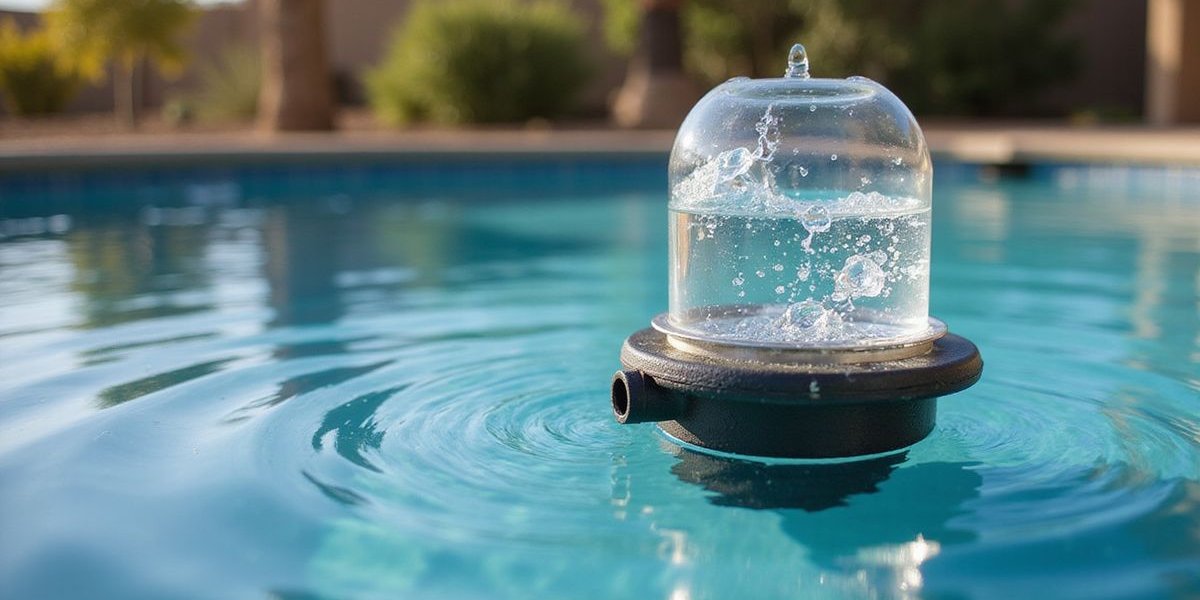
You turn the system on, but the pot (strainer basket) never fills with water. Air bubbles might shoot continuously out of the return jets, or the water level in the pump basket creates a “cyclone” effect without filling up.
Common Causes
This is almost always a “suction side” leak, meaning air is being pulled into the system before the impeller.
- Dry-rotted Lid O-ring: The rubber seal under your pump lid cracks easily in dry heat.
- Low Water Level: If the pool water drops below the skimmer weir, the pump sucks air.
- Stuck Skimmer Weir: The flapper door in the skimmer may be jammed, blocking water entry.
- Loose Drain Plugs: The winterizing plugs on the pump housing might be creating a vacuum leak.
What to Do
Start with the lid O-ring, as it causes nearly 80% of priming issues we encounter.
- Turn off the system and remove the pump lid.
- Inspect the O-ring for cracks, flatness, or dirt.
- Lubricate it with a silicone-based lube (like Magic Lube), never petroleum jelly.
- Refill the pot with a bucket of water and restart.
If the pump still won’t prime after these steps, the issue may be a clog in the underground suction line or a damaged impeller.
Sign #3: Reduced Water Flow
What You Will Notice
The water pressure coming out of your return jets feels weak. Your automatic pool cleaner might move sluggishly or stop climbing the walls entirely.
Diagnosing with Filter Pressure
The pressure gauge on your filter tank is your best diagnostic tool here.
- High Pressure (10+ PSI over clean): The filter is dirty and resisting flow. The pump is working fine, but the water has nowhere to go.
- Low Pressure: The pump is not pulling enough water. This points to a clogged pump basket, a clogged impeller, or a suction leak.
Common Causes beyond the Filter
Clogged Impeller: Small debris like pine needles or palo verde seeds can pass through the basket and get stuck in the impeller veins.
Suction Valves: Ensure your intake valves (skimmer and main drain) are fully open.
Undersized Piping: If you recently upgraded to a high-horsepower pump without upgrading pipes, the pump may be choking for flow.
What to Do
Follow this order of operations to save time.
- Clean the pump basket and skimmer baskets.
- Backwash or clean your filter elements.
- Check the pressure gauge again.
- If flow is still low with a clean filter, the impeller likely needs professional clearing.
Sign #4: Tripping Breaker
What Is Happening
The pump starts up and runs for a few seconds or minutes before tripping the electrical breaker. You reset the switch, and it happens again immediately.
What It Means
Amp Draw Spike: The motor is pulling more electricity than it is rated for, causing the breaker to cut power as a safety measure.
Short to Ground: The insulation on the internal copper windings has melted or broken down, causing electricity to escape.
Moisture Intrusion: Rain or a shaft seal leak has allowed water to enter the electrical motor housing.
Warning
A tripping breaker is a critical fire safety warning, not a suggestion. We strongly advise against forcing the breaker back on repeatedly.
- Do not replace the breaker with a larger size to “handle” the load; this can melt your wires.
- Do not ignore the heat coming off the motor housing.
- Do shut off power at the main panel and call for service.
Sign #5: Visible Leaks
Where Leaks Occur
Water pooling under your equipment pad is often the first visual sign of failure.
- Shaft Seal: This mechanical seal sits behind the impeller. When it fails, water drips down the back of the seal plate, often corroding the motor.
- Discharge Pipe: The PVC fitting leaving the top of the pump can warp from heat.
- Pump Housing: Freeze damage or old age can cause hairline cracks in the plastic body.
Why It Matters
A “small drip” is rarely just a water loss issue. That dripping water frequently contains salt or chlorine, which eats through the motor’s metal casing and ruins the front bearings.
What to Do
Look for white crusty buildup (calcium) around the base of the motor.
- Shaft Seal: This is a routine repair costing significantly less than a new motor.
- Housing Crack: This usually requires replacing the “wet end” or the entire pump.
- Fitting Leaks: These can often be fixed with high-temp thread sealant or a new fitting.
Sign #6: Age and Efficiency Decline
How Old Is Too Old?
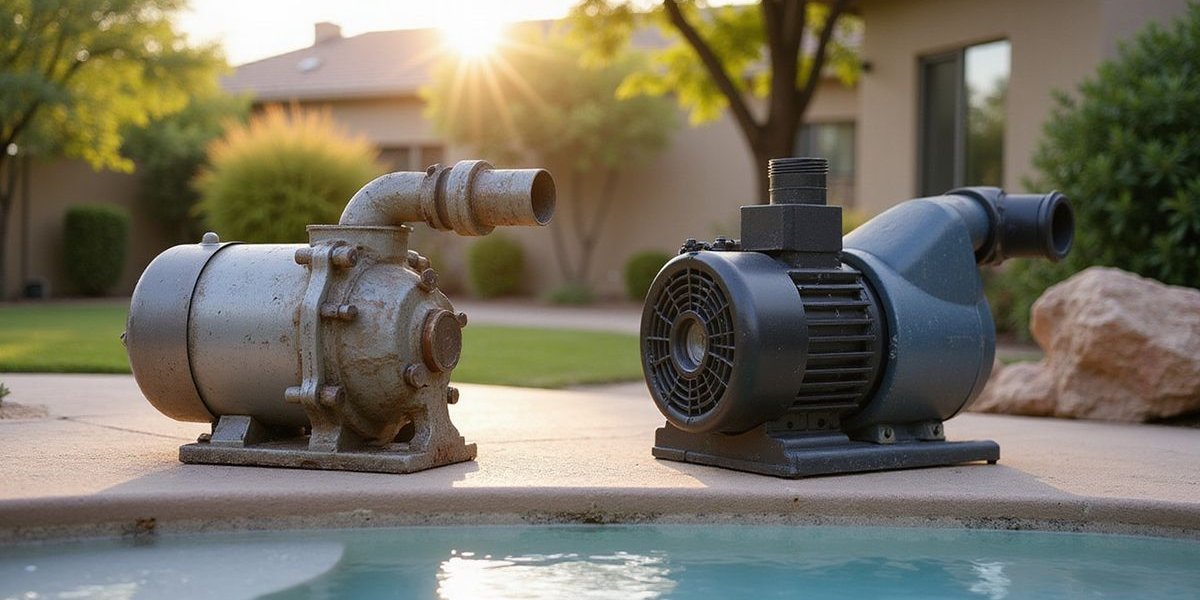
Equipment in the desert ages in “dog years.” While a pump might last 12 years in cooler climates, the UV exposure and heat load here reduce that expectancy.
| Pump Type | Average AZ Lifespan | Energy Usage |
|---|---|---|
| Single Speed | 6-10 years | High |
| Variable Speed | 8-12 years | Low |
| Two Speed | 7-10 years | Medium |
The Arizona Title 44 Factor
State regulations now generally prohibit installing new single-speed filtration pumps over 1 horsepower. If your older single-speed unit fails, you will likely be upgrading to a variable-speed (VS) model by law.
Signs of Age-Related Decline
- The motor runs extremely hot to the touch.
- Your electric bill has crept up noticeably.
- Plastic components are brittle and cracking.
- The pump sounds louder than it did two years ago.
Repair vs. Replace: Decision Guide
Usually Worth Repairing
If the pump is under 7 years old and the motor is sound, repairs are often the smart choice.
| Repair | Typical Cost | Notes |
|---|---|---|
| Start Capacitor | $120 - $180 | Simple fix for humming motors |
| Shaft Seal | $150 - $250 | Essential to save the motor |
| O-rings/Gaskets | $80 - $150 | Routine maintenance |
| Impeller Clear | $100 - $150 | Labor only (usually) |
Usually Better to Replace
We generally recommend replacement if the repair cost exceeds 50% of the value of a new pump.
- Motor Failure: A new motor installation runs $500-$800.
- Multiple Issues: If you need a motor and a wet end, a new pump is cheaper.
- Old Tech: Replacing a 10-year-old single-speed pump with a new single-speed motor is throwing good money after bad efficiency.
The Variable Speed Advantage
Modern variable-speed pumps pay for themselves quickly.
- Energy Savings: Running at lower RPMs can save Phoenix homeowners $400-$600 annually.
- Utility Rebates: SRP and APS frequently offer rebates ranging from $100 to $150 for Energy Star-certified pumps.
- Longevity: They run cooler and quieter, reducing heat-related wear.
Emergency vs. Planned Replacement
If Your Pump Fails Completely
A stagnant pool in summer turns green in about 48 hours.
- Add Chlorine Manually: Use liquid chlorine and brush the pool vigorously to mix it.
- Remove Debris: Skim the surface often, as the skimmers are not working.
- Do Not Drain: Never drain a pool in summer without professional guidance, as the shell can crack.
Better: Plan Ahead
Waiting for total failure usually means paying emergency rates and settling for whatever pump is in stock.
- Listen: Pay attention to those new noises.
- Budget: Plan for replacement when the pump hits the 8-year mark.
- Upgrade Early: Installing a VS pump now starts the savings immediately.
Our Approach
David Resurface believes in honest diagnostics over aggressive sales. When we inspect a struggling pump, we look at the whole picture—age, condition, and your energy goals.
We calculate the real-world cost of keeping an old unit running versus the immediate savings of a modern system. Our team will verify if your specific problem is a simple $20 O-ring fix or a terminal motor failure.
Contact us if your pump is showing any of these warning signs, and let’s get your water moving again.
Related Topics
Need Pool Resurfacing Help?
Get expert advice and a free estimate for your pool project. We serve the entire Phoenix metro area.
Get Free Estimate