Stamped Concrete Pool Decks: Pros, Cons, and Costs
Stamped concrete offers the look of high-end stone or brick at a fraction of the cost. But is it the right choice for your Arizona pool deck? Let’s look at the full picture.
What Is Stamped Concrete?
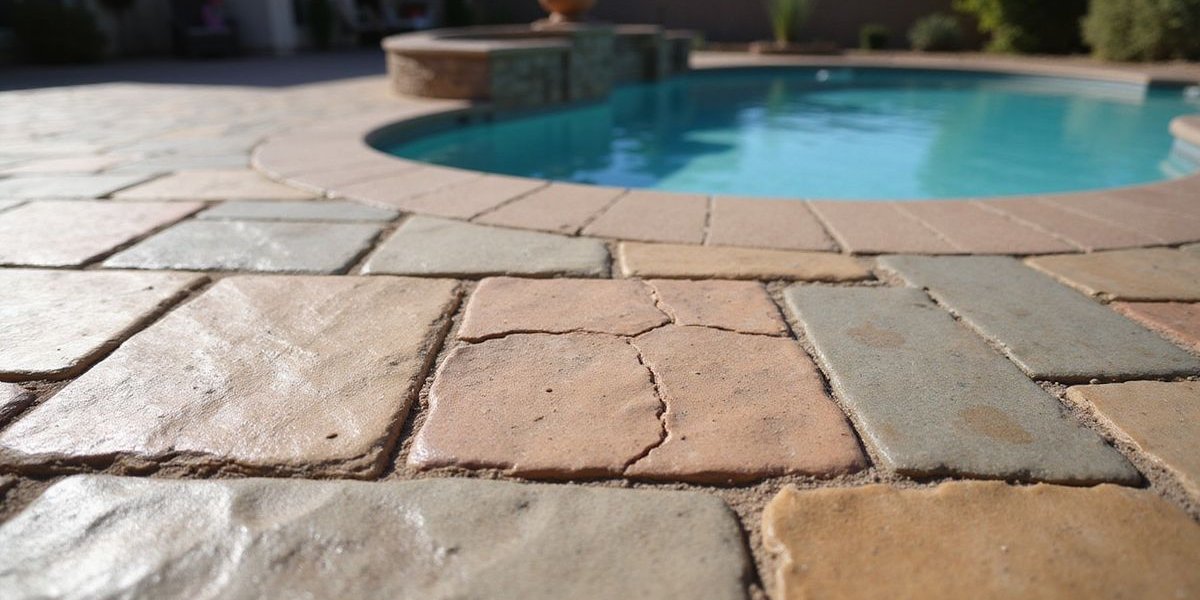
Stamped concrete is a decorative system that imitates expensive materials using poured concrete and specialized molds. We apply patterns and colors to resemble surfaces like:
- Natural stone (flagstone, slate)
- Brick or pavers
- Wood planks
- Custom textures
For pool decks, this is typically applied as an overlay during pool deck resurfacing. This method involves spreading a thin layer of specialized concrete over your existing deck.
Stamped Concrete Pros
Aesthetic Appeal
Versatile Design Options We have access to dozens of pattern choices and unlimited color combinations. You can mimic materials that would otherwise cost a fortune. Custom designs allow you to match the deck to your home’s exterior perfectly.
Upscale Appearance A well-executed stamped deck looks remarkably like natural stone. It provides a seamless surface without the weed-prone joints you find in pavers. This upgrade can increase home value. Real estate photos always pop with a freshly stamped deck.
Cost Effectiveness
Lower Than Natural Stone Our data shows stamped concrete generally costs 30-50% less than actual flagstone. It runs about 40-60% less than travertine. The price point is comparable to mid-range pavers but offers a higher-end look.
Single Installation There is no need for individual unit installation. Projects move faster because we pour or spread the material at once. This process is significantly less labor-intensive than laying thousands of individual pavers.
Durability
Long Lifespan A stamped deck can last 15-25+ years with proper care. It won’t shift or settle like pavers often do after a heavy monsoon. There are no individual pieces to crack or replace. You get a solid, unified surface that stands up to foot traffic.
Stamped Concrete Cons
Heat Concerns
The Arizona Challenge Stamped concrete retains heat much like standard grey concrete. On a typical 110°F Phoenix day, the surface requires caution.
- Surface temps can reach 140-150°F without shade.
- Dark colors absorb significantly more heat.
- The texture provides minimal cooling benefit.
- Walking barefoot can be uncomfortable or dangerous during peak sun hours.
Mitigation Options We always recommend choosing lighter colors like tan, cream, or light gray to reflect UV rays. Applying a specialized heat-reflective sealer helps reduce surface temperature. Installing the deck in shaded areas or under patios is ideal. You might also combine it with acrylic lace (Cool Deck) in high-traffic zones.
Slip Resistance Issues
The “Slippery When Wet” Factor Standard sealed concrete is non-porous and becomes incredibly slick when water hits it. This is a major safety concern around a pool.
The Mandatory Fix We mix a micronized polymer additive, often called “Shark Grip,” directly into the final sealer coat. This creates a gritty texture that provides traction. Without this additive, stamped concrete is not safe for wet feet.
Maintenance Requirements
Sealing Needed You must reseal the deck every 2-3 years in the Arizona sun. The sealer protects the color from UV degradation and the concrete from water damage. An unsealed surface will fade and chalk rapidly.
Cleaning Considerations The textured surface tends to trap dust and dirt in the grooves. Some deeper patterns are harder to sweep than smooth surfaces. Pressure washing is effective, but you must be careful not to strip the sealer.
Potential Issues
Cracking All concrete cracks eventually. Stamped concrete is no exception to this rule. Control joints must be planned into the design to guide where these cracks occur.
Color Fading Intense UV exposure fades colors over time. Darker colors (like deep reds or browns) fade more noticeably than earth tones. Regular sealing is the only way to minimize this fading.
Repair Challenges Matching a repair to existing work is difficult due to weathering. Color matching years later is nearly impossible. Large repairs often require resurfacing the entire area to ensure a uniform look.
Cost Breakdown
Price Per Square Foot (2025-2026 Estimates)
Labor rates and material costs in Phoenix have adjusted these ranges recently.
| Complexity Level | Price Range |
|---|---|
| Basic single-color | $12-16/sq ft |
| Standard two-color | $15-20/sq ft |
| Premium multi-color | $18-24/sq ft |
| Custom/complex | $22-30/sq ft |
For a 600 Sq Ft Pool Deck
| Option | Total Cost |
|---|---|
| Basic stamped overlay | $7,200-9,600 |
| Standard stamped | $9,000-12,000 |
| Premium stamped | $10,800-14,400 |
What Affects Price
- Pattern complexity: Intricate patterns require more time and precision.
- Color applications: Each additional color layer (highlighting or antiquing) adds labor.
- Surface preparation: Grinding down old glue or repairing cracks increases prep time.
- Size: Larger projects usually have a lower cost per square foot due to efficiency.
- Accessibility: If we cannot get equipment into the backyard easily, hand-labor costs rise.
New Pour vs. Overlay
Fresh Pour Stamped Concrete
Best when:
- You have no existing deck or the current deck is structurally unsound.
- New construction is taking place.
- Maximum durability is the priority.
Pros:
- This is the strongest option available.
- We have full control over thickness and rebar reinforcement.
- The pattern impression is usually deeper and more defined.
Cons:
- The cost is higher because it often includes demolition.
- Installation takes longer.
- Your backyard will be a construction zone for a week or more.
Stamped Overlay
Best when:
- The existing concrete is flat and in good structural shape.
- Your budget is limited.
- You need a faster turnaround time.
Pros:
- Costs are significantly lower than a fresh pour.
- No heavy demolition is required.
- We can typically finish installation in 3-5 days.
Cons:
- Success depends entirely on the condition of the substrate (the old concrete).
- The application is thinner (typically 1/4 to 3/8 inch).
- Delamination (peeling) is a risk if prep isn’t perfect.
Popular Patterns for Arizona Pools
Flagstone
Most popular choice:
- This pattern offers a natural and organic appearance.
- It blends seamlessly with desert landscaping and xeriscaping.
- Earth tones hide dust well.
- The classic look rarely goes out of style.
Slate
Modern appeal:
- Clean lines define this look.
- It suits contemporary architecture and geometric pools.
- The texture is often smoother than flagstone.
- Uniform patterns make small spaces look larger.
Brick/Cobblestone
Traditional charm:
- This mimics a classic Mediterranean aesthetic.
- It pairs beautifully with Tuscan-style homes common in Phoenix.
- The warm appearance is inviting.
Random Stone
Natural diversity:
- Varied stone sizes create visual interest.
- The organic layout hides minor imperfections in the concrete.
- Each installation looks unique.
- It is excellent for freeform pools.
Stamped Concrete vs. Alternatives
Vs. Cool Deck (Acrylic Lace)
| Factor | Stamped Concrete | Cool Deck |
|---|---|---|
| Heat performance | Hot (140°F+) | Cooler (105-115°F) |
| Appearance | Decorative stone look | Standard textured solid color |
| Cost | Higher ($12+/sq ft) | Lower ($6-9/sq ft) |
| Lifespan | 15-25 years | 10-15 years |
Vs. Pavers
| Factor | Stamped Concrete | Pavers |
|---|---|---|
| Appearance | Realistic imitation | Authentic individual stones |
| Cracking | Likely over time | None (flexible system) |
| Repair ease | Difficult | Easy (swap out bricks) |
| Heat | Similar | Similar |
| Cost | Lower | Higher |
Vs. Travertine
| Factor | Stamped Concrete | Travertine |
|---|---|---|
| Heat | Hot | Naturally Cool |
| Appearance | Good imitation | Natural Luxury |
| Cost | Lower | Higher ($20+/sq ft) |
| Lifespan | 15-25 years | 40+ years |
Making Your Decision
Choose Stamped Concrete If:
- You want the aesthetic of stone without the high price tag.
- Your deck is in a shaded area or under a patio cover.
- Aesthetics are more important to you than surface temperature.
- You are willing to reseal the deck every few years.
- A seamless surface is a priority for you.
Reconsider If:
- Heat is your primary concern for children or pets.
- You want the coolest possible surface for barefoot walking.
- Low-maintenance is your top goal.
- Visible hairline cracks would bother you.
- You have a salt water pool (salt eats away at sealers aggressively).
Our Recommendation
For Phoenix pool decks, stamped concrete works well in specific situations.
Best applications:
- Covered patio areas that transition to the pool.
- North-facing backyards that receive afternoon shade.
- Accent borders combined with Cool Deck in the main walking areas.
- Homeowners who want a specific designer look on a budget.
Consider alternatives for:
- Full-sun pool surrounds with no shade.
- Families with young children who run barefoot.
- Anyone prioritizing maximum heat reduction.
We can help you evaluate your specific situation and whether stamped concrete makes sense for your pool deck. Contact us for a free consultation.
Related Topics
Need Pool Resurfacing Help?
Get expert advice and a free estimate for your pool project. We serve the entire Phoenix metro area.
Get Free Estimate